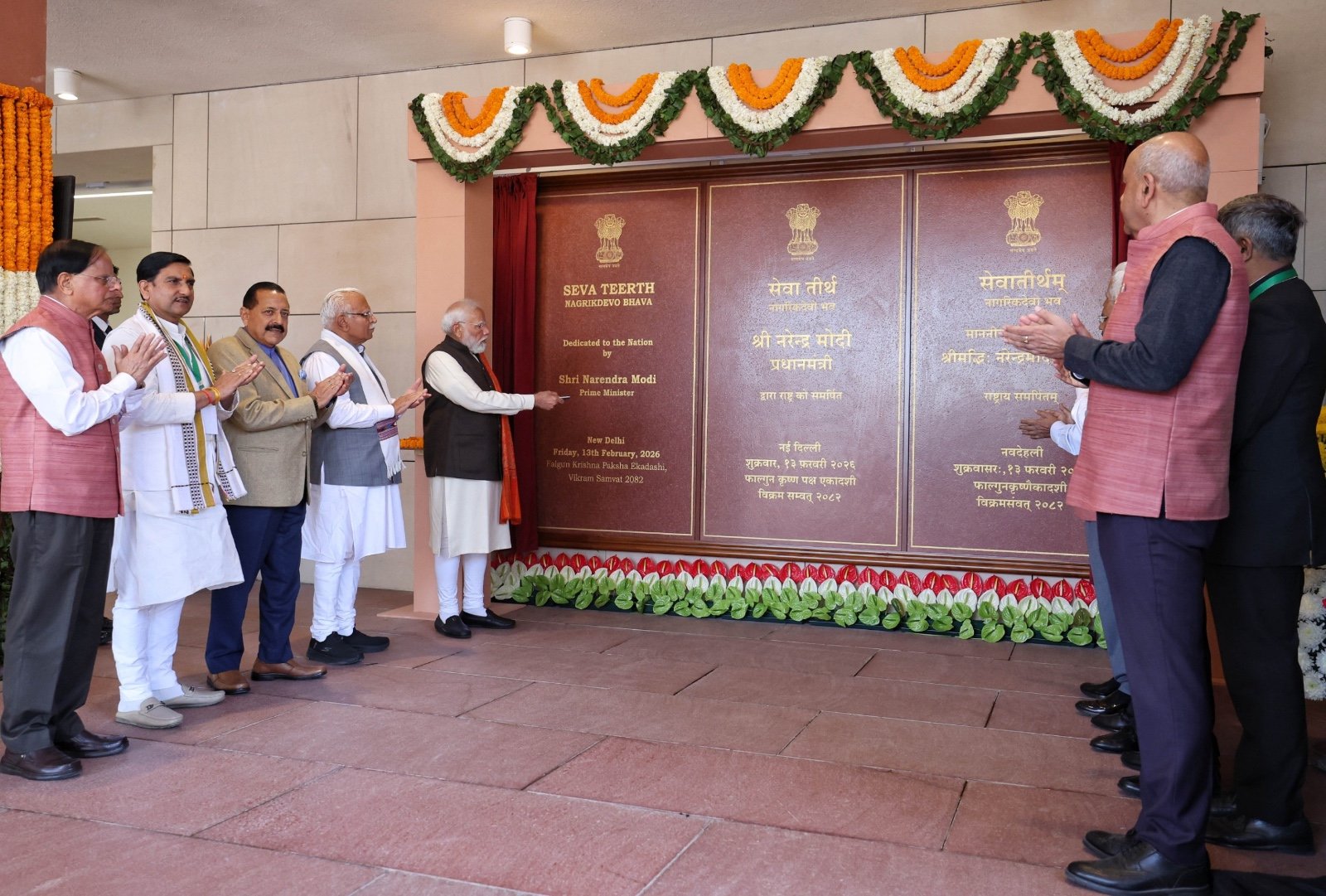
New Delhi, February 24, 2026: Under the chairmanship of Prime Minister Narendra Modi, the Union Cabinet held its historic first meeting at the newly established Prime Minister’s Office complex, ‘Seva Teerth’.
The Cabinet reaffirmed its commitment to advancing the national mission of Viksit Bharat 2047, aimed at transforming India into a developed nation by the centenary of independence.
‘Seva Teerth’ Symbolises New India’s Transformation
The Union Cabinet described ‘Seva Teerth’ as a living embodiment of New India’s transformation. After decades of governance operations from South Block, the new complex reflects India’s indigenous thinking, modern outlook, and boundless aspirations.
The site holds historical significance, as it replaces temporary barracks built during the British era. The establishment of a modern governance centre at this location has been termed a symbol of India’s renewal and institutional reform.
Governance Rooted in Duty, Service and Dedication
According to the Cabinet, the concept of ‘Seva Teerth’ is built on the harmonious blend of material progress and human values. Inspired by the principles of duty, service, and dedication, the workplace aims to strengthen the connection between governance and public service.
The Cabinet resolved that every decision taken at Seva Teerth will be guided by the welfare of 140 crore citizens and the larger goal of nation-building. Emphasising the spirit of “Citizen First,” the government reiterated its focus on transparent, accountable, and responsive administration.
Commitment to Constitutional Values
The Cabinet highlighted that the work culture at Seva Teerth will be aligned with the core spirit of the Constitution. Policies will prioritise dignity, equality, and justice for all citizens, reinforcing inclusive governance.
Achievements in Welfare and Economic Reforms
The meeting also acknowledged major socio-economic transformations achieved in recent years. The Cabinet noted that over 25 crore citizens have been lifted out of poverty. Landmark initiatives such as Ayushman Bharat, Pradhan Mantri Garib Kalyan Anna Yojana, Swachh Bharat Mission, Jal Jeevan Mission, and housing schemes have significantly improved the quality of life for millions.
Reforms including GST, Direct Benefit Transfer (DBT), Digital India, and faceless tax systems have enhanced transparency and strengthened public trust in governance. These measures have positioned India among the world’s leading economies.
Targeting Top Three Global Economies
With renewed energy from Seva Teerth and accelerated reforms, the Union Cabinet reiterated its resolve to position India among the world’s top three economies in the near future.
The Cabinet stated that the new governance culture emerging from Seva Teerth will play a pivotal role in shaping a strong, self-reliant, and developed India by 2047, serving as a central hub for national aspirations and the future of generations to come.