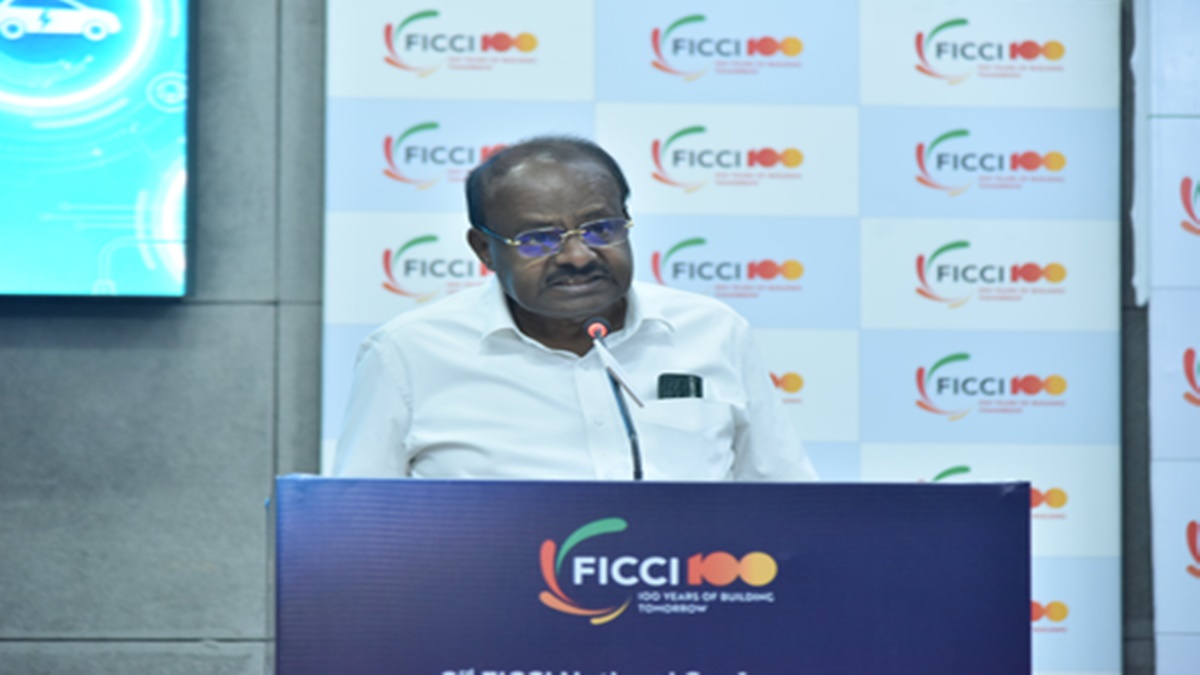
New Delhi: With clear policy direction and strong industry participation, India can firmly establish itself as a global hub for electric mobility manufacturing and innovation, Union Minister for Heavy Industries and Steel H. D. Kumaraswamy said.
Speaking to the media during the third session of the Federation of Indian Chambers of Commerce and Industry (FICCI) National Conference on Electric Vehicles, the Minister emphasized that the government is committed to adopting the best strategies to promote electric mobility adoption.
Electric Mobility Key to ‘Viksit Bharat 2047’ Vision
Kumaraswamy stated that as India moves toward the ‘Viksit Bharat 2047’ vision, electric mobility must remain central to the Make in India agenda.
He highlighted the importance of strengthening domestic manufacturing, boosting localisation, and positioning India as a global production hub for electric vehicles (EVs), batteries, and critical components.
Over the past decade, India’s automotive component exports have nearly doubled, increasing from around $8 billion to $16.9 billion. The Minister said this growth reflects India’s deeper integration into global value chains and its growing credibility as a reliable manufacturing destination.
EV Market to Touch Trillion-Dollar Mark
Former NITI Aayog CEO Amitabh Kant said the global electric vehicle market is projected to reach the trillion-dollar mark in the next decade.
He noted that global supply chains are being reorganised, with countries rethinking localisation strategies and strategic dependencies. According to him, India must strengthen its position as a trusted manufacturing hub for electric vehicles amid this global shift.
Kant added that electric mobility is not only a climate necessity but also a significant economic, industrial, technological, and strategic opportunity. The transition to EVs should be treated as a core pillar of the Viksit Bharat 2047 roadmap.
From Green Mobility 1.0 to 2.0
FICCI Green Mobility Committee Co-Chair Vikram Handa said India has successfully moved from “Green Mobility 1.0” to “2.0” by building a comprehensive EV value chain.
This ecosystem now includes:
- Processing of critical minerals
- Cell manufacturing
- Battery pack assembly
- Production of two-wheelers, three-wheelers, four-wheelers, buses and trucks
- Charging infrastructure development
Industry leaders believe this integrated approach reflects India’s strategic direction and highlights immense growth potential in the electric mobility sector.
With policy support, industry collaboration, and technological innovation, India aims to accelerate its transition to electric mobility while strengthening its global manufacturing footprint.