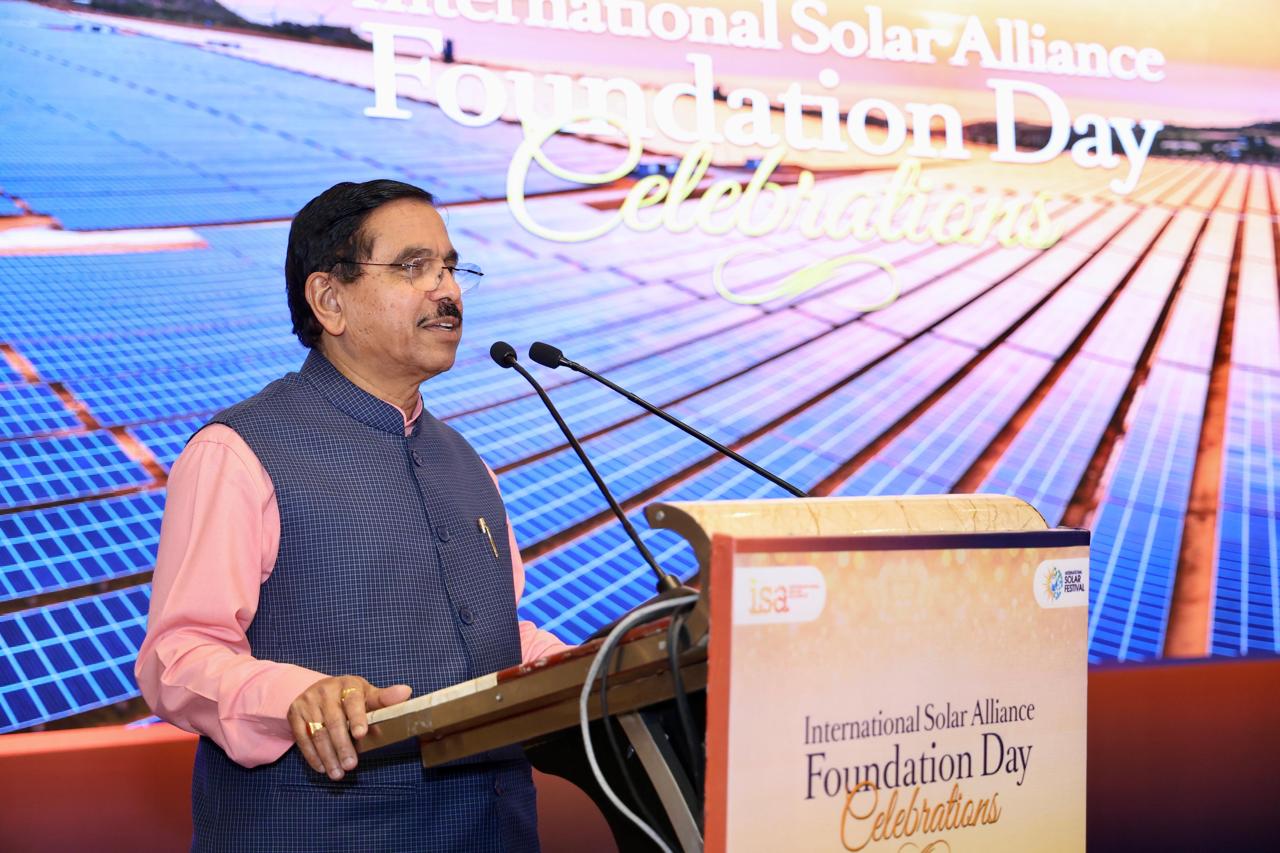
India’s installed solar power capacity has reached nearly 136 gigawatts (GW), accounting for almost half of the country’s total renewable energy capacity, Union Minister for New and Renewable Energy Pralhad Joshi said on Thursday.
The minister made the remarks while addressing the Foundation Day celebrations of the International Solar Alliance (ISA) in New Delhi.
He said the rapid expansion of solar energy in India reflects the government’s strong policy commitment and continuous innovation in the clean energy sector.
International Solar Alliance Driving Global Solar Transition
Pralhad Joshi highlighted the role played by the International Solar Alliance in promoting global cooperation in solar energy adoption and advancing the transition toward sustainable energy.
“Over the past decade, the International Solar Alliance has helped turn the promise of solar energy into real, life-changing impact across the world,” the minister said.
He added that the organisation has played a catalytic role in expanding solar deployment, particularly in emerging and developing economies.
The alliance, launched as a global initiative, has now grown into a coalition of more than 120 countries working together to accelerate the use of solar power worldwide.
Government Schemes Boost Solar Adoption in India
The minister also highlighted several flagship government initiatives aimed at expanding solar energy in India.
These include:
- PM Surya Ghar: Muft Bijli Yojana, which enables households to generate clean electricity through rooftop solar systems.
- Pradhan Mantri Kisan Urja Suraksha evam Utthaan Mahabhiyan, which supports farmers in adopting solar-powered irrigation pumps.
According to Joshi, these programmes are helping accelerate the adoption of clean and affordable solar energy across households and agricultural sectors.
Global Solar Capacity Expanding Rapidly
The minister noted that the pace of solar energy adoption worldwide is increasing rapidly.
While it took nearly 25 years for the world to install the first 1,000 GW of solar capacity, the next 1,000 GW is expected to be achieved much faster, reflecting the growing momentum of the clean energy transition.
Global South Emerging as Clean Energy Hub
Joshi also said the centre of the global clean energy transition is gradually shifting toward the Global South, where rising energy demand and abundant solar resources are creating new opportunities for sustainable development.
In this context, he said the International Solar Alliance serves as a platform that brings together governments, financial institutions, development partners and private sector stakeholders to expand solar deployment.
ISA Members Driving Global Solar Mission
Speaking at the event, Ashish Khanna said member countries and partner organisations are playing a key role in advancing the alliance’s mission.
“Our members across Africa, Asia and the Pacific, Latin America and the Caribbean, and Europe are the true custodians of ISA’s progress,” he said.
He added that partner organisations and young solar professionals are also contributing significantly to the growth of the global solar movement.
India–France Initiative Launched at COP21
The International Solar Alliance was jointly launched by India and France during the United Nations Climate Change Conference 2015 under the leadership of Prime Minister Narendra Modi.
The initiative aims to promote solar energy adoption globally and accelerate the transition to clean and sustainable energy systems.