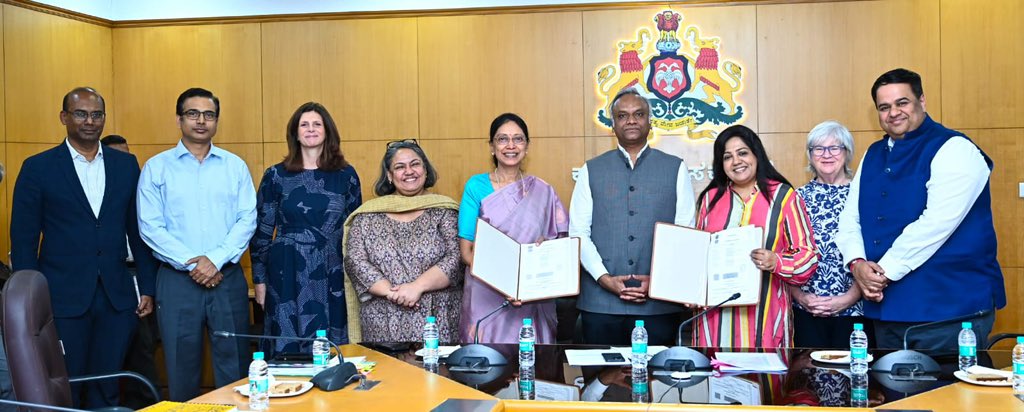
The Karnataka government has constituted a Committee on Responsible Artificial Intelligence (AI) to develop a comprehensive policy framework for the safe, transparent, and accountable use of AI in government systems and technologies that impact citizens.
The committee is chaired by Kris Gopalakrishnan, co-founder of Infosys, and co-chaired by N Manjula, Secretary of the Department of Electronics, Information Technology, Biotechnology and Science & Technology.
The panel includes experts from industry, academia, law, and public policy, aiming to create a balanced governance framework for emerging AI technologies.
First Meeting Held in Bengaluru
The committee held its first meeting in Bengaluru on Thursday, where members discussed the rapidly evolving AI ecosystem and the urgent need for clear governance mechanisms for technologies that affect citizens.
According to an official statement, the committee will develop a Responsible AI policy and implementation roadmap for Karnataka. The goal is to encourage innovation while ensuring AI systems used by the government remain safe, fair, transparent, and accountable.
Interim Report in 60 Days, Final Recommendations in 90 Days
Officials said the panel will submit:
- An interim report within 60 days
- A final set of recommendations within 90 days
The report will outline a policy framework, a risk classification system for AI applications used in governance, and a roadmap for implementation across government departments.
Framework to Classify AI Risks and Set Ethical Guidelines
The committee is examining ways to develop Responsible AI principles and policy guidelines for the state.
It will also create a framework to categorize AI applications based on their risk level and societal impact.
The panel is expected to identify AI practices that should be restricted or prohibited, including:
- Social scoring of citizens
- Unlawful or disproportionate surveillance
- Discriminatory profiling or exclusion
- Automated decision-making in high-stakes situations without human oversight
Safeguards for High-Risk AI Applications
The committee will recommend review mechanisms and safeguards for high-risk AI systems used in sectors such as:
- Welfare delivery
- Healthcare
- Education
- Policing
- Recruitment
- Financial decision-making
- Public safety
Discussions are also focusing on data governance, privacy protections, transparency standards, cybersecurity safeguards, and the implications of generative AI and social media technologies.
Additionally, the panel will develop procurement guidelines and vendor due-diligence frameworks for AI systems adopted by government departments.
Karnataka Aims to Lead Responsible AI Development
Karnataka IT/BT Minister Priyank Kharge said the initiative aims to balance technological innovation with safeguards as the state expands its AI ecosystem.
According to Kharge, the committee will help Karnataka create a governance model that promotes innovation while protecting transparency, accountability, and citizen trust.
Kris Gopalakrishnan also welcomed the initiative, stating that Karnataka has the potential to become the first Indian state to build a comprehensive Responsible AI framework, which could enhance public services, create new technology jobs, and strengthen the state’s innovation ecosystem.
Government Reviewing Data Centre Policy
Responding to a query by BJP MLA Dheeraj Muniraj, Kharge said 32 private data centres currently operate in Karnataka, and the state is reviewing its existing data centre policy.
The minister noted that data centres are essential for AI, machine learning, and emerging technologies, but they also require large amounts of water and energy resources.
He explained that a 1-megawatt data centre requires around ₹70 crore in investment and about one acre of land, while also consuming nearly 25 million litres of water annually.
Focus on Sustainable Data Centres in Coastal Karnataka
The government is exploring a “sustainable data centre” policy and considering coastal regions such as Mangaluru for future facilities.
Kharge said hyperscale data centres — typically requiring more than 40 megawatts of power — may not be suitable for Bengaluru due to water constraints and lack of a port.
He added that the government has written to the Union telecom ministry seeking support for establishing a subsea cable landing station in Mangaluru, while also holding discussions with private companies.
Debate Over Data Centre Infrastructure
During the discussion, Dheeraj Muniraj alleged that Bengaluru is losing potential data centre investments due to the absence of dedicated data centre parks.
He suggested that new facilities could be developed in the proposed KWIN City near Doddaballapur, where around 6,000 acres of land are currently being acquired for development.